
Structured Cabling System (Copper & Fiber)
Description
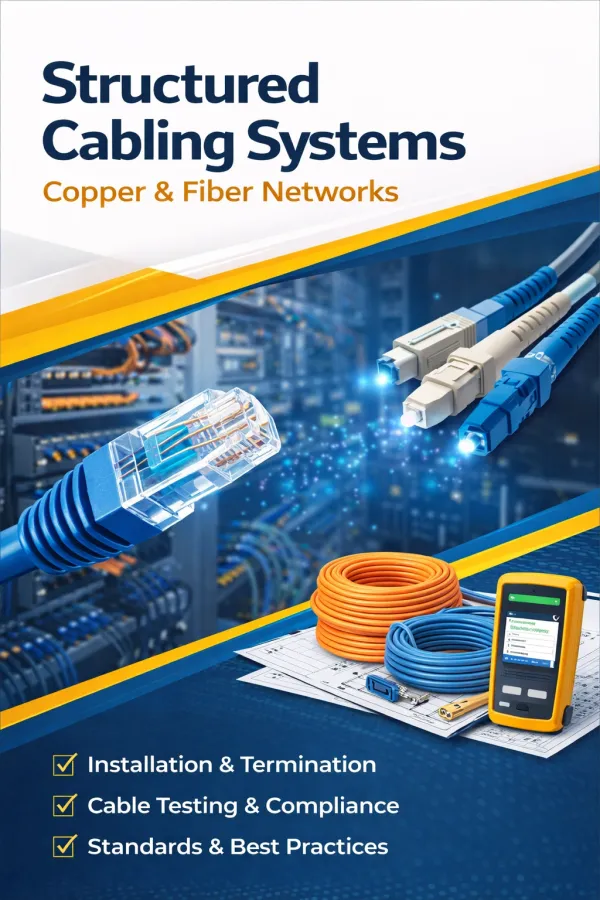
This module provides a comprehensive overview of Structured Cabling Systems used in modern buildings and infrastructure projects. It covers copper and fiber optic cabling technologies, cabling types, international standards, system components, installation practices, routing methods, testing procedures, and cable administration.
The training combines theoretical understanding with practical site execution, focusing on real project environments, installation practices, cable management, testing requirements, and maintenance considerations aligned with international standards such as TIA/EIA, ISO/IEC, and BICSI guidelines.
What You Will Gain
- Understanding of Structured Cabling Systems and their importance in communication networks.
- Knowledge of copper and fiber optic cabling technologies.
- Understanding of international standards such as TIA‑568, TIA‑569, ISO/IEC 11801, and BICSI.
- Practical understanding of UTP cable structure, categories, and termination standards.
- Knowledge of patch panels, racks, and cable management practices.
- Understanding of bandwidth, data rates, and conductor characteristics affecting performance.
- Knowledge of fiber optic communication principles and applications.
- Understanding of cable installation, routing, and pathway practices.
- Knowledge of copper and fiber optic cable testing procedures.
- Understanding of labeling and documentation practices according to TIA‑606.
Skills You Will Develop
- Understand structured cabling infrastructure used in buildings.
- Identify and select appropriate copper or fiber cable types.
- Apply correct cable termination using T568A and T568B standards.
- Install horizontal and backbone cabling systems.
- Manage patch panels and rack‑based cable organization.
- Evaluate cable performance based on bandwidth and conductor characteristics.
- Understand fiber optic transmission and applications.
- Apply proper cable routing methods using trays, conduits, and trunking.
- Conduct copper and fiber cable testing procedures.
- Implement cable labeling and documentation practices.
Module Structure Overview
Session 1 – Introduction & Structured Cabling Fundamentals
Session 2 – Types of Network Cabling (UTP, Fiber Optic, Coaxial, Color Coding, Patch Panels, Bandwidth)
Session 3 – Components of Structured Cabling (Entrance Facility, Equipment Room, Backbone Cabling, Horizontal Cabling, Work Area)
Session 4 – Fiber Optics (Types, Working Principle, Applications, Testing)
Session 5 – Basics on Execution (Cable Installation Guidelines, Cable Routing, Cable Labeling)
Target Audience
- Project Engineers
- Testing & Commissioning Engineers
- QA/QC Engineers
- Network Engineers
- Site Supervisors
- Low Current System Integrators
- IT Infrastructure Engineers
- Technicians involved in communication system installations
Methodology
- Structured technical presentations
- Practical diagrams and examples
- Project-based discussions
- Testing workflow demonstrations
- Scenario-based troubleshooting
- Interactive Q&A sessions
Training Outcome
By the end of this module, participants will be able to understand, install, and verify structured cabling systems using both copper and fiber technologies. They will gain the practical knowledge required to plan cabling infrastructure, follow installation standards, perform testing procedures, and maintain organized communication cabling systems that meet project requirements and international standards.
Lecture: Imran Khan
Last updated: 24/03/2026
Requirements
No Requirements!
Browse Similar Courses
Below, you will find courses similar to the one you have selected.